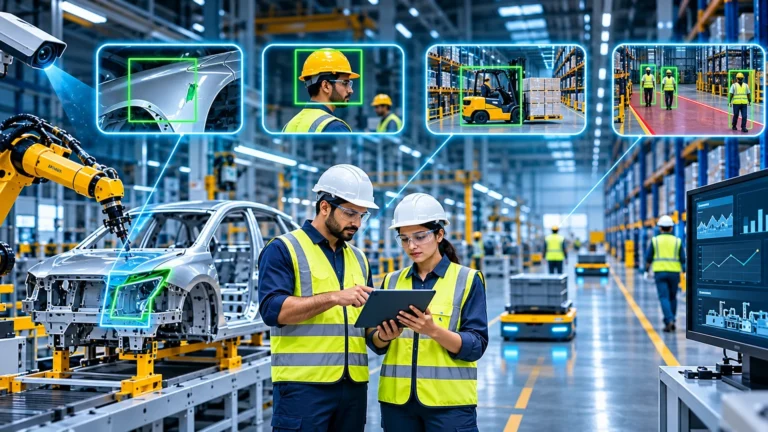
Manufacturing environments generate enormous amounts of visual information every day. Every component moving along a production line, every assembly operation performed by an operator, and every product passing through an inspection station presents an opportunity to understand and improve manufacturing performance.
Yet, much of this information remains underutilized.
Traditional manufacturing systems primarily rely on predefined automation rules, manual supervision, and periodic quality inspections. While these approaches have enabled large-scale production, they do not always provide the flexibility and visibility required to manage increasingly complex manufacturing operations.
Artificial Intelligence (AI) and computer vision are changing this landscape.
By enabling machines to interpret images and videos, recognize patterns, and identify deviations, computer vision is helping manufacturers gain a deeper understanding of what is happening across their facilities.
Its applications now extend beyond automated inspection to include production monitoring, workplace safety, assembly verification, material handling, and operational analysis.
The result is a new approach to manufacturing in which visual information becomes an important source of operational intelligence.
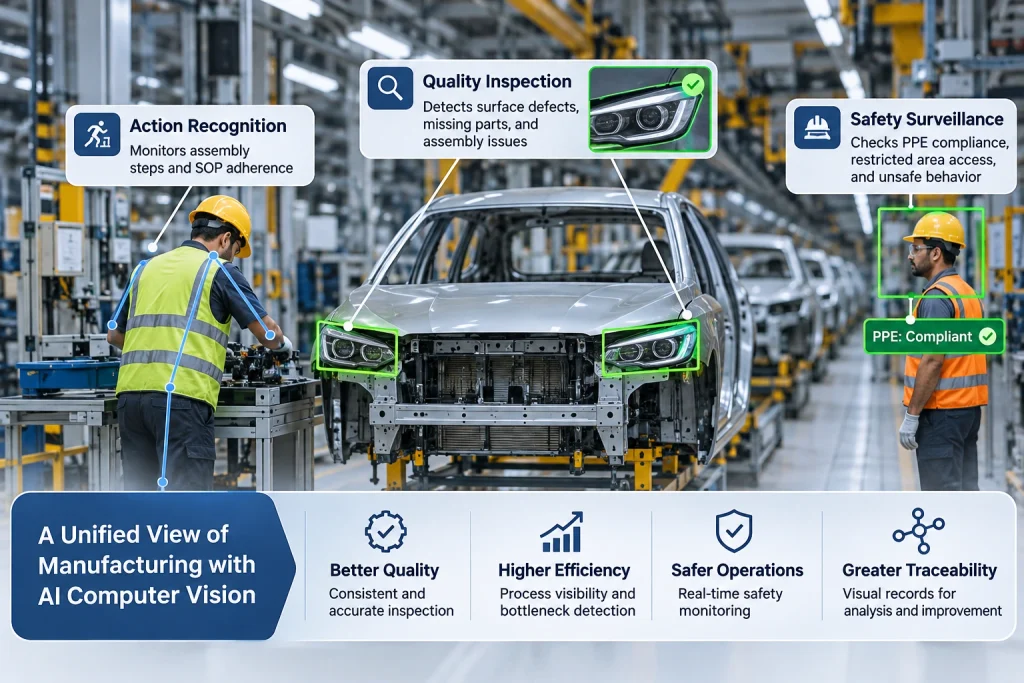
Why Manufacturing Needs Visual Intelligence
Modern factories operate through a combination of machines, people, materials, and interconnected production processes.
Even when manufacturing equipment is automated, several important activities still require human involvement. Component handling, assembly, material movement, inspection, and safety supervision are examples of processes where continuous monitoring can be challenging.
Manufacturers commonly encounter situations such as:
- Quality variations that are identified only during final inspection.
- Incorrect assembly sequences that lead to rework.
- Components with subtle defects that are difficult to identify manually.
- Production delays caused by inefficient workstation activities.
- Safety violations that go unnoticed during routine supervision.
- Limited visibility into actual shop-floor operations.
These challenges are not necessarily caused by a lack of automation. In many cases, they arise because manufacturers lack sufficient visibility into the activities and conditions influencing production.
Computer vision addresses this gap by converting visual information into structured data that can be analyzed and used to support operational decisions.
How AI and Computer Vision Work Together in Industrial Environments
Computer vision enables machines to interpret visual information, while AI and deep learning help them recognize more complex patterns and relationships within that information.
An industrial computer vision system generally consists of several interconnected elements.
Visual Data Capture
Industrial cameras, IP cameras, infrared cameras, and other imaging devices capture images and video streams from production environments.
The camera configuration depends on the application, inspection area, component characteristics, and environmental conditions.
Image Processing and Analysis
Captured visual data is processed to identify relevant objects, patterns, activities, or abnormalities.
Depending on the requirement, the system may analyze individual images or continuous video streams.
AI Model Interpretation
Deep learning models are trained to recognize specific objects, classify defects, identify activities, or detect deviations from expected conditions.
Different AI techniques are used depending on the application, including object detection, image classification, segmentation, OCR, and pose estimation.
Insights and Operational Response
The system converts its findings into actionable outputs such as inspection results, alerts, notifications, and dashboard information.
These outputs can also be integrated with industrial automation and enterprise systems to support operational workflows.
This combination enables computer vision to move beyond image capture and become an active part of industrial decision-making.
Where Computer Vision Is Making a Difference in Manufacturing
The applications of AI vision vary depending on the manufacturing process, product type, and operational requirements. Some of the most relevant applications include the following.
Intelligent Quality Inspection
Quality inspection is one of the most established applications of computer vision in manufacturing.
Manufactured components can develop defects during machining, casting, welding, painting, assembly, and other production activities.
Identifying these defects consistently is essential to maintaining product quality.
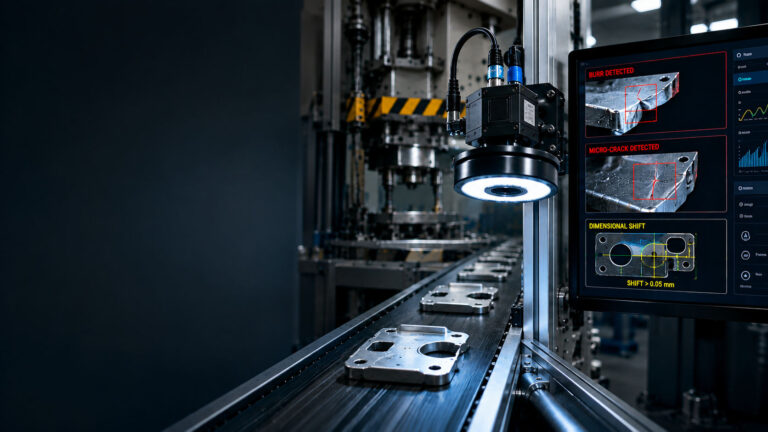
AI-powered inspection systems can analyze component images and identify visual abnormalities, including:
- Scratches, dents, and surface imperfections.
- Cracks and casting defects.
- Missing or incorrectly positioned components.
- Dimensional variations.
- Colour and coating inconsistencies.
- Incorrect assembly conditions.
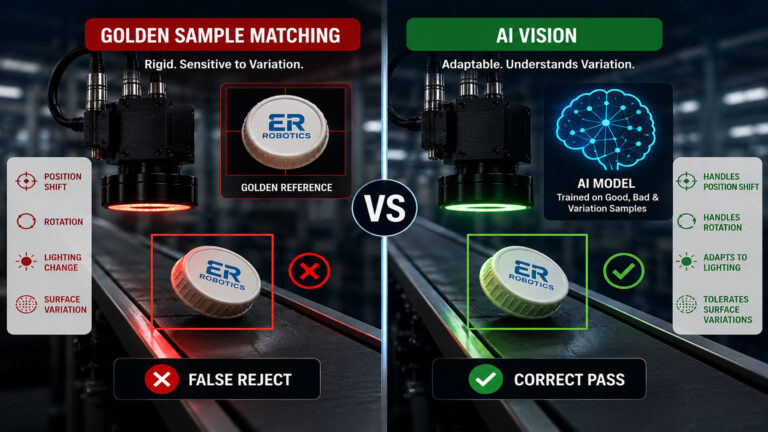
Unlike conventional inspection approaches that depend entirely on predefined visual rules, deep learning models can learn defect patterns from representative image datasets.
This makes them useful for applications involving variations in component appearance, surface texture, and defect characteristics.
Understanding Assembly-Line Activities
A manufacturing process is influenced not only by the quality of the final product but also by how individual operations are performed.
An incorrect assembly sequence, inconsistent component handling, or deviation from prescribed work instructions can affect production quality and efficiency.
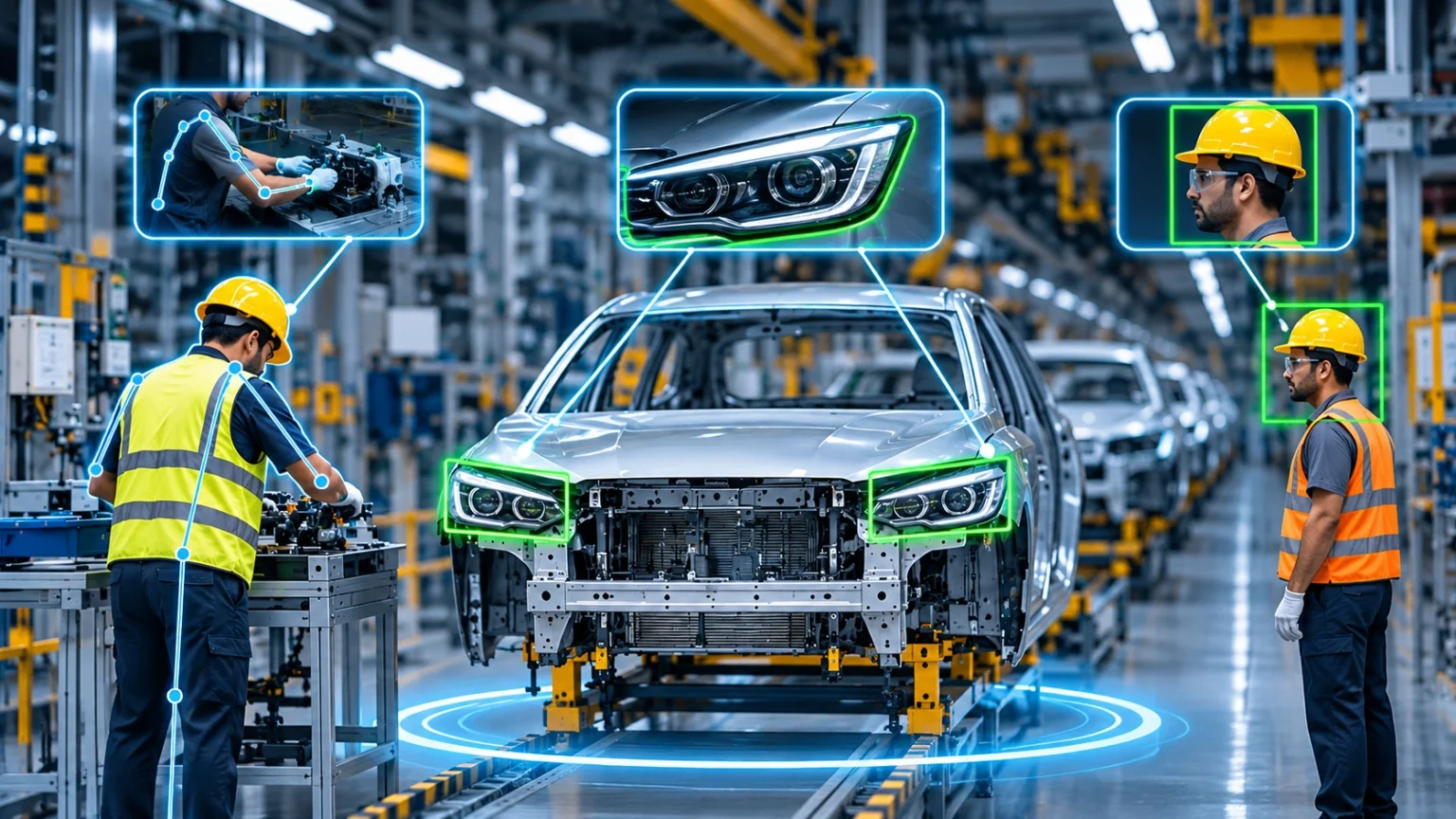
AI-based action recognition can analyze video streams to identify activities performed by operators and compare them with expected workflows.
For example, in an automotive assembly operation, a vision system can identify whether an operator has completed a predefined sequence of activities before proceeding to the next operation.
Other applications include monitoring pick-and-place activities, analyzing workstation movements, identifying process deviations, and evaluating adherence to standard operating procedures.
This provides manufacturers with a better understanding of actual shop-floor activities rather than relying exclusively on manual observations or production reports.
Monitoring Industrial Safety
Industrial safety requires continuous attention, particularly in environments involving moving machinery, robotic systems, heavy equipment, and restricted operational areas.
AI-powered surveillance systems can analyze camera feeds to identify predefined safety violations and potentially hazardous situations.
Applications include:
- Detection of missing personal protective equipment.
- Monitoring access to restricted areas.
- Identification of unauthorized entry.
- Virtual geofencing around hazardous zones.
- People counting and movement monitoring.
- Fall and unsafe posture detection.
These capabilities can help safety teams identify situations requiring attention and improve visibility across large industrial facilities.
Computer vision complements existing safety procedures and human supervision; it does not replace the need for appropriate safety controls and workplace policies.
Improving Material Handling and Production Flow
Material movement is an important part of manufacturing operations.
Delays in material handling, inefficient movement between workstations, and incorrect placement of components can affect overall production flow.
Computer vision can support material handling activities by identifying objects, monitoring movement, and analyzing operational sequences.
For example, AI models can be configured to recognize material placement, verify pick-and-place operations, and monitor the movement of objects across designated areas.
When combined with production information, these insights can help identify operational bottlenecks and opportunities to improve workflow efficiency.
Vehicle and Component Identification
Automotive and industrial manufacturing facilities handle numerous components, assemblies, and finished products that require accurate identification.
OCR and object recognition technologies can extract information from labels, serial numbers, printed codes, and other visual identifiers.
These technologies can support component identification, batch tracking, vehicle recognition, and inspection documentation.
By connecting visual identification with manufacturing databases, organizations can improve information accuracy and strengthen production traceability.
Moving from Isolated Cameras to Connected Manufacturing Intelligence
One of the important developments in industrial computer vision is the ability to connect visual analysis with existing manufacturing infrastructure.
Historically, cameras have primarily been used for security monitoring or specific inspection tasks. However, modern AI vision platforms can support a much wider range of industrial applications.
Consider an automotive manufacturing facility where different systems perform different functions:
- Inspection cameras identify defects in manufactured components.
- Surveillance cameras monitor workplace safety.
- Video analytics systems understand operator activities.
- Industrial sensors provide information about machine conditions.
- Manufacturing systems maintain production and quality records.
When these systems operate independently, their information may remain fragmented.
An integrated industrial vision architecture can bring these capabilities together through centralized analytics, dashboards, alerts, and system integrations.
This allows manufacturers to evaluate different aspects of their operations using a combination of visual and industrial data.
Integration with PLCs, MES, ERP, SCADA, and other systems can further support automated workflows and more informed decision-making.
What Should Manufacturers Consider Before Implementing AI Vision?
Although AI vision offers considerable potential, selecting and deploying the right solution requires a clear understanding of the manufacturing application.
- Define the Operational Requirement: Manufacturers should begin by identifying the specific problem they want to address. A defect inspection application requires a different approach from workplace safety monitoring or action recognition.
- Evaluate the Visual Environment: Lighting, camera positioning, production speed, component characteristics, and environmental conditions can influence system performance.
- Build Representative Training Data: AI models require relevant data to recognize the objects, defects, or activities associated with a particular application. The quality and diversity of the training data are important considerations.
- Determine the Deployment Architecture: Depending on latency, connectivity, security, and infrastructure requirements, manufacturers may choose edge, on-premise, cloud, or hybrid deployment.
- Plan for Integration: The solution should be evaluated in the context of existing production systems, equipment, and operational workflows.
- Monitor Performance Over Time: Changes in products, processes, and environmental conditions can influence AI model performance. Periodic evaluation and model improvement are important for maintaining reliability.
A well-defined implementation strategy helps ensure that computer vision addresses an actual operational requirement rather than becoming another disconnected technology deployment.
Hypervise: Bringing Visual Intelligence to Industrial Operations
As manufacturing organizations explore more comprehensive applications of AI, there is a growing need for platforms that can address multiple operational requirements through computer vision.
Eternal Robotics developed Hypervise, an Industrial Vision AI Platform that applies deep learning and video analytics to industrial environments.
The platform is organized around three functional areas:
1. Inspection: Focused on visual quality and automated inspection applications, including defect detection, dimensional checks, object counting, colour analysis, OCR, and other specialized inspection requirements.
2. Action Recognition: Focused on understanding activities and workflows within industrial environments through action sequencing, time and motion analysis, pick-and-place monitoring, postural analysis, and SOP adherence.
3. Surveillance: Focused on monitoring industrial environments for safety and security requirements, including PPE detection, intrusion monitoring, virtual geofencing, people monitoring, and other surveillance applications.
Hypervise is designed to work with different industrial camera technologies and supports edge, on-premise, cloud, and hybrid deployment architectures.
Its integration capabilities include industrial and enterprise systems such as PLC, MES, ERP, VMS, and SCADA.
The three capabilities address different aspects of manufacturing operations, bringing quality inspection, process monitoring, and workplace safety into the broader scope of industrial visual intelligence.
The Next Phase of Manufacturing: Decisions Driven by Visual Data
The evolution of manufacturing technology is moving beyond equipment automation towards greater awareness of production activities and operating conditions.
AI-powered computer vision is an important part of this development because it enables machines to interpret visual information that was previously dependent on human observation.
As deep learning models, edge computing, industrial cameras, and connected manufacturing systems continue to evolve, visual intelligence will find applications across increasingly diverse production environments.
Manufacturers will be able to use visual data not only to inspect products but also to understand process variations, improve operational discipline, strengthen workplace safety, and support continuous improvement.
The opportunity is to make manufacturing environments more observable and their operations more measurable.
A smarter factory is not defined only by how much equipment it automates, but also by how effectively it understands and responds to what happens across its operations.