In the world of industrial automation and quality control, the reliability of a vision system is paramount. For decades, manufacturers have relied on a method known as Golden Sample matching. However, as production lines become faster and products more complex, the limitations of this rigid approach are becoming costly bottlenecks. Understanding the differences between Golden Sample Matching vs. AI is essential for facility managers looking to reduce false reject rates and improve throughput.
Key Takeaways
- Rigidity vs. Flexibility: Golden Sample matching relies on predefined patterns and strict comparison criteria, while AI utilizes adaptive feature recognition.
- The Cost of Variation: Traditional systems can struggle when lighting changes or parts shift position, potentially leading to higher false reject rates.
- AI Learning: Artificial intelligence can learn acceptable variations, enabling more flexible inspection than rigid image-matching approaches.
- Improved Inspection: AI-powered vision can help manufacturers improve inspection consistency while accommodating normal variations in production conditions.
What Is Golden Sample Matching?
Golden Sample matching is a traditional machine vision approach in which a camera captures an image of a product and compares it against a predefined reference image or pattern known as the Golden Sample.
If the captured image deviates from the reference beyond a predefined threshold, the system may flag the part for further inspection or classify it as defective. While this approach can be effective in highly controlled environments, it can struggle to distinguish between an actual defect and harmless variations caused by positioning, lighting, or surface conditions.
The Failure: Why Rigid Pattern Matching Breaks Down
The fundamental challenge with the Golden Sample approach is its limited tolerance for environmental and positional variation. In a perfectly controlled environment, reference-based matching can work effectively. However, real-world factory floors are rarely perfectly controlled.
When comparing Golden Sample Matching vs. AI, traditional reference-based approaches can struggle with scenarios such as:
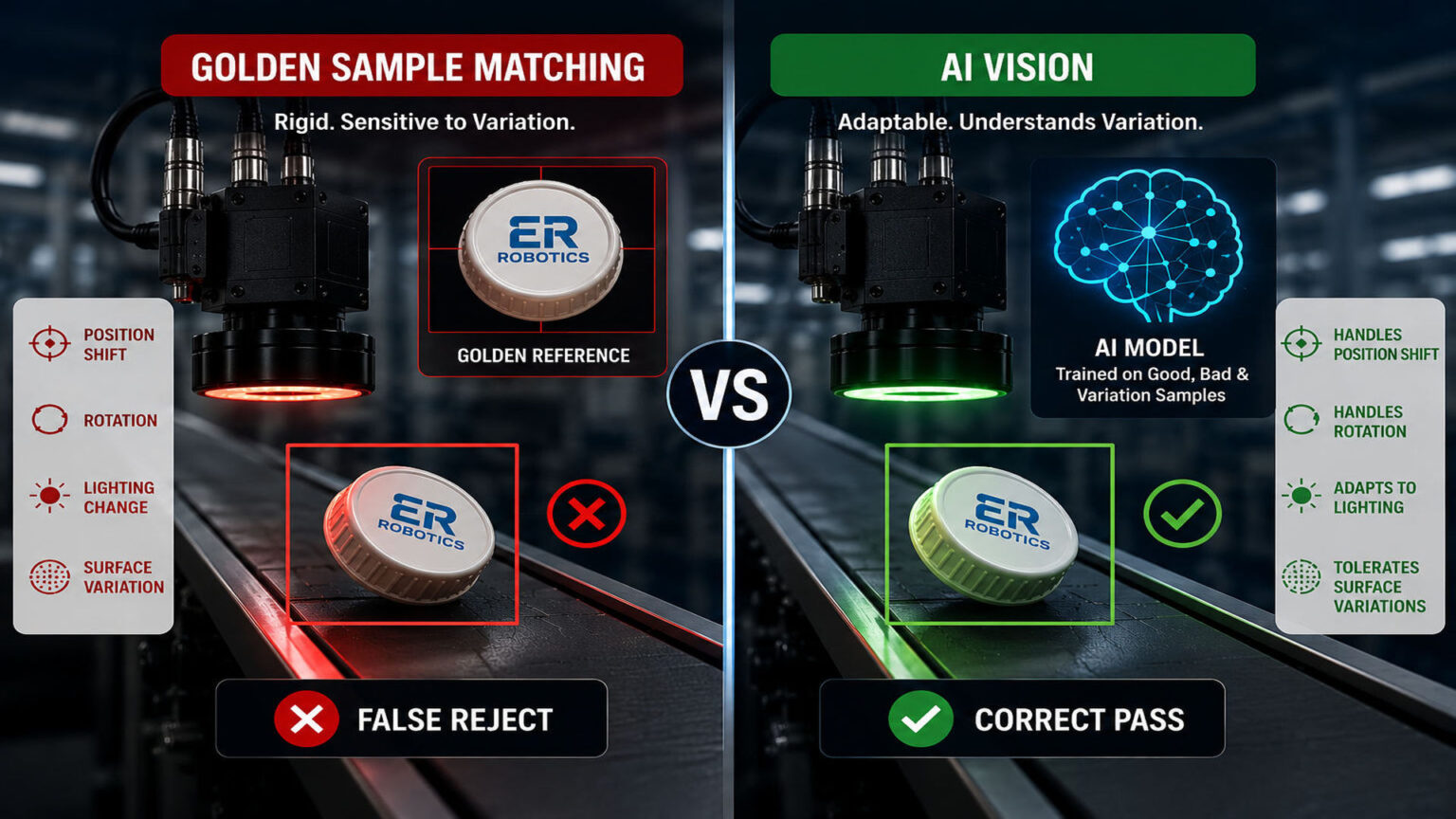
- Positioning Shifts: If a part moves slightly on the conveyor belt or rotates during inspection, its features may no longer align precisely with the reference image. The system may interpret this misalignment as a defect, potentially triggering a false reject.
- Lighting Fluctuations: A shadow from a nearby object, changes in ambient lighting, or variations in illumination can alter the appearance of a part. A reference-based system may interpret these changes as differences from the stored image, increasing the risk of incorrect rejection.
- Surface Texture Variations: Acceptable variations, such as the natural grain of a metal part or a slight change in the sheen of a plastic component, can be flagged when they differ significantly from the reference pattern.
These limitations can make conventional pattern matching less suitable for inspection environments where part position, lighting, or surface appearance varies during production.
The Fix: AI and Acceptable Variation
Artificial intelligence (AI) and deep learning can address some of the limitations of rigid pattern matching by changing how the inspection system analyzes visual information. Instead of relying solely on direct image comparison, AI-powered systems can analyze features and patterns learned from inspection data.
AI systems typically learn from datasets containing examples of good parts, defective parts, and acceptable variations, rather than relying on a single reference image.
Through this training process, an AI model can learn to identify relevant features and distinguish genuine defects from normal variations within the defined quality criteria.
For example, if a label is rotated slightly but remains legible and correctly positioned, an appropriately trained AI system can classify this as an acceptable variation. A rigid reference-matching system may be more likely to reject the part if the label no longer aligns precisely with the stored reference image.
Comparison: Golden Sample Matching vs. AI
The following table outlines the key operational differences between these two approaches to visual inspection.
| Feature | Golden Sample (Rule-Based) | Artificial Intelligence (Deep Learning) |
|---|---|---|
| Comparison Method | Compares the inspected image against a predefined reference image or pattern. | Uses feature extraction and pattern recognition based on training data. |
| Tolerance to Rotation | Generally low and may require precise positioning or fixturing. | Can accommodate a range of orientations when appropriately trained. |
| Lighting Sensitivity | Can be sensitive to shadows and changes in illumination. | Can be more tolerant of lighting variations when appropriately trained and configured. |
| Setup Process | Relatively quick initial setup, but may require extensive rule and threshold tuning. | Requires representative training data and validation before deployment. |
| Primary Failure Mode | Can produce false rejects when normal variations differ significantly from the reference. | Performance depends heavily on the quality, diversity, and representativeness of the training data. |
Visualizing the Difference
To understand the operational impact, imagine a bottle-cap inspection line.
- Scenario A — Golden Sample: The bottle cap is rotated 10 degrees clockwise. The system may flag the part because the logo no longer aligns with the stored reference pattern. The system has limited ability to contextualize whether the rotation is acceptable.
- Scenario B — AI Vision: The same bottle cap is rotated 10 degrees. An appropriately trained AI system can identify the logo, verify that the text is correct, check the seal integrity, and determine whether the rotation falls within the defined acceptance criteria.
This difference in processing logic is one reason manufacturers are exploring AI-powered vision systems for applications where rigid pattern matching can produce excessive false rejects.
If your production line suffers from high scrap rates due to false rejects, it may be time to upgrade from rigid pattern matching. Book a demo to see the difference.
Frequently Asked Questions
Golden Sample matching can produce false rejects because it relies on predefined reference patterns and thresholds. Variations caused by vibration, lighting changes, positioning, or slight rotation can cause the inspected image to differ from the reference, even when the part may still meet the required quality criteria.
The initial software and implementation investment for AI-powered vision can be higher than that of some traditional pattern-matching solutions. However, the overall return on investment (ROI) can be favorable when AI helps reduce false rejects, scrap, manual inspection effort, and unnecessary mechanical fixturing.
The actual ROI depends on the application, production volume, defect rate, implementation cost, and inspection requirements.
Not necessarily. The amount of training data required depends on the application, defect types, product variation, and AI model being used.
Modern AI vision platforms can use techniques such as transfer learning and synthetic data generation to reduce data requirements in some applications. However, representative and high-quality training data remains important for achieving reliable inspection performance.
Not necessarily. Traditional rule-based vision systems remain useful for applications involving highly controlled conditions, straightforward presence/absence checks, or precise dimensional measurements.
AI-powered vision can be particularly advantageous for applications involving complex defect detection, assembly verification, surface inspection, and cosmetic quality assessment where acceptable variation needs to be distinguished from genuine defects.
The right approach depends on the specific inspection requirement, product characteristics, production environment, and required level of accuracy.