In the highly competitive vehicle manufacturing industry, surface quality is paramount. Automotive paint defect detection is a critical stage in the production line, ensuring that every vehicle leaving the factory meets rigorous aesthetic and durability standards. However, inspecting glossy, metallic, and clear-coated surfaces presents unique challenges that traditional machine vision systems often struggle to address.
Key Takeaways
- The Glare Problem: Traditional cameras can be affected by specular reflections on shiny car bodies, potentially masking critical defects.
- AI-Powered Solution: AI-powered computer vision can analyze complex surface patterns to distinguish defects from reflection-induced artifacts.
- Improved Efficiency: Automated inspection can reduce manual inspection time while improving consistency and defect detection across metallic and glossy surfaces.
What Is Automotive Paint Defect Detection?
Automotive paint defect detection is the automated process of identifying surface irregularities—such as scratches, inclusions, pinholes, and orange peel—on vehicle bodies using advanced imaging systems and AI-powered computer vision.
Unlike manual inspection, which can be subjective and affected by operator fatigue, automated detection provides consistent quality control by analyzing visual characteristics and surface patterns to identify imperfections before the vehicle reaches the customer.
The Challenge: Why Traditional Cameras Struggle with Shiny Surfaces
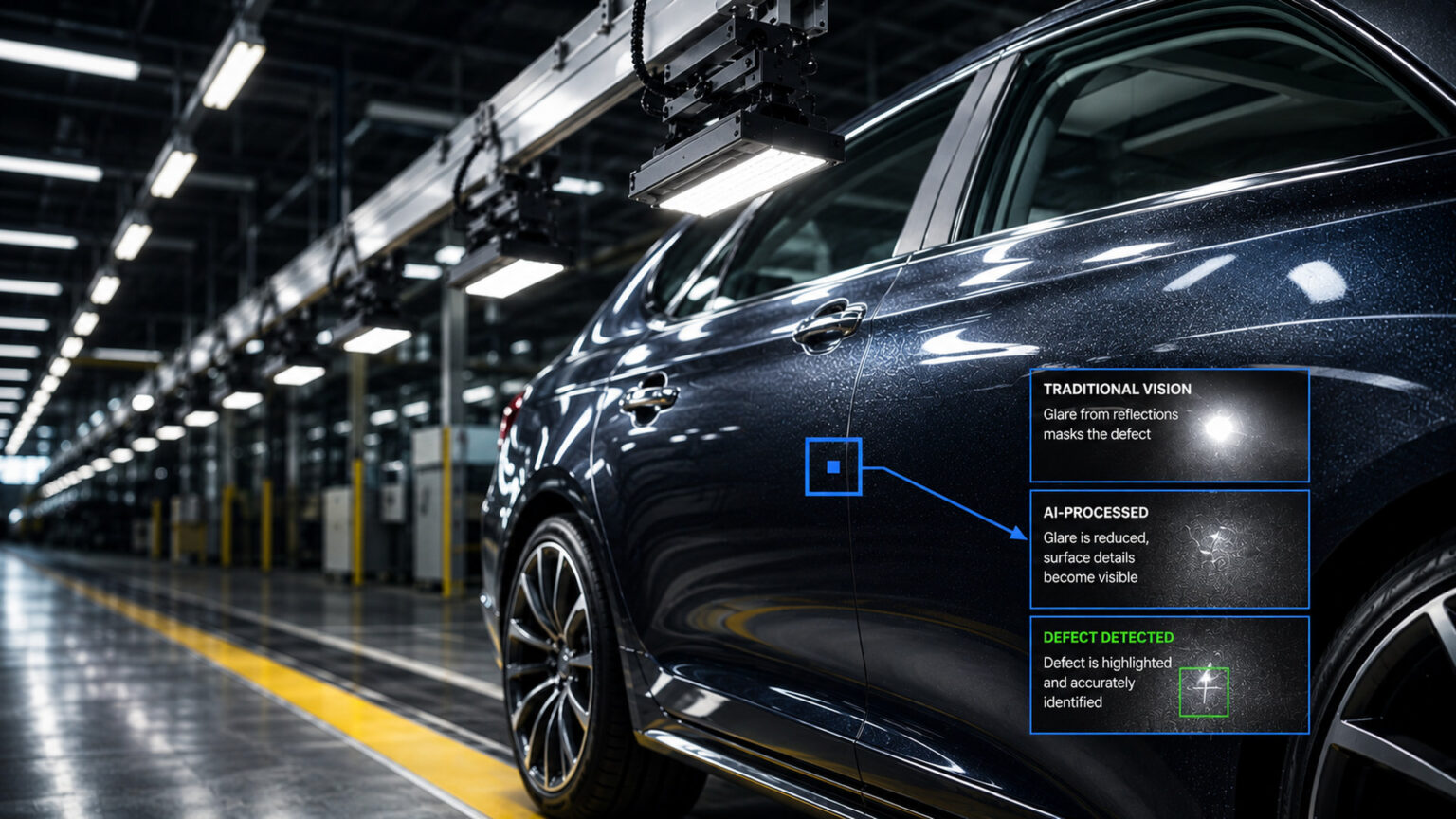
The primary obstacle in automating paint inspection is the nature of the surface itself. Automotive finishes are designed to be highly reflective. When traditional machine vision cameras inspect a glossy or metallic car body, they encounter a phenomenon known as specular reflection.
Standard cameras rely on reflected light to capture an image of an object. On a mirror-like surface, high-intensity lighting can create strong reflections and glare that overexpose parts of the image, potentially hiding defects located within or near the affected area. Similarly, dark areas on curved surfaces may reflect the surrounding environment rather than accurately representing the surface texture.
As a result, traditional systems can generate false positives by identifying reflections as defects or false negatives by missing actual defects that are obscured by glare.
The Solution: How Hypervise Uses AI for Paint Inspection
To overcome the limitations of conventional optical inspection, manufacturers are increasingly exploring AI-powered computer vision platforms. Hypervise, an AI-powered industrial computer vision platform, provides a modern approach to automotive paint defect detection by combining computer vision and AI to analyze complex surface conditions.
Instead of relying solely on conventional image-processing rules, Hypervise is designed to analyze visual patterns across different surface conditions and distinguish genuine surface anomalies from reflection-induced artifacts.
This helps reduce the impact of glare and environmental reflections, enabling more reliable detection of subtle defects such as:
- Micro-scratches: Fine abrasions that can be difficult to identify under conventional lighting conditions.
- Orange Peel: Uneven surface texture resembling the skin of an orange, often associated with paint application and curing conditions.
- Pinholes: Tiny imperfections or craters in the paint layer that can result from trapped solvents, air, or other coating-related issues.
- Surface Inclusions: Foreign particles or contaminants embedded in or present on the painted surface.
Comparison: Traditional Vision vs. AI-Powered Inspection
The following table outlines the operational differences between traditional machine vision systems and modern AI-powered approaches to paint inspection.
| Feature | Traditional Machine Vision | Hypervise AI-Powered Inspection |
|---|---|---|
| Glare Management | Can be affected by specular highlights and may require controlled lighting and optical filters. | AI-based analysis helps distinguish surface defects from reflection-induced artifacts. |
| Surface Compatibility | Can face challenges when inspecting metallic, glossy, and clear-coated finishes. | Designed to support inspection of high-gloss, metallic, and curved surfaces. |
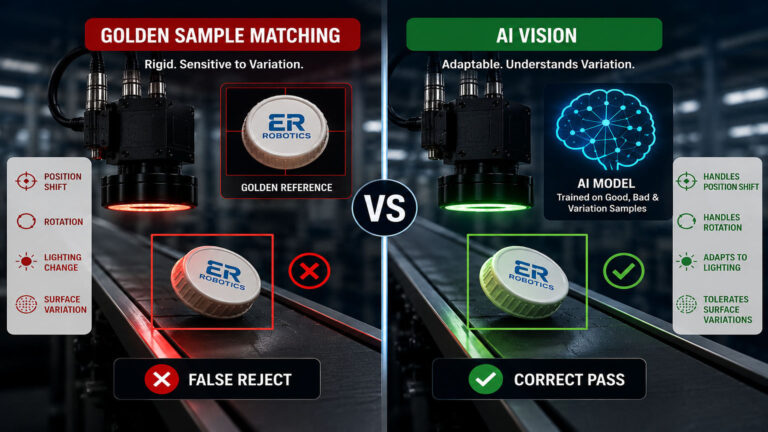
| Defect Identification | Often relies on predefined rules and thresholds, which can result in reflections or dust being classified as defects. | Uses AI-based visual analysis to distinguish actual defects from environmental and surface variations. |
| Setup Complexity | May require carefully controlled lighting and inspection environments. | Designed to provide greater flexibility across different inspection conditions. |
The Role of Lighting in Defect Visibility
Proper lighting is the hardware counterpart to AI-powered inspection. In automotive paint defect detection, the angle of incidence can determine whether a defect is clearly visible or hidden by reflections.
Two commonly used lighting approaches are:
- Dark-Field Illumination: Light is directed at a low angle. On a flat, defect-free surface, much of the light reflects away from the camera. When a scratch, particle, or other surface irregularity is present, it scatters light toward the camera, making the defect more visible against a darker background.
- Bright-Field Illumination: Light is directed so that it reflects toward the camera. Surface defects can appear as darker areas where the reflected light is scattered away from the lens.
Hypervise combines appropriate imaging and lighting strategies with AI-based analysis to improve defect visibility and inspection consistency across different lighting conditions and surface finishes.
Stop guessing with glare. Book a demo to test your shiny parts.
Frequently Asked Questions
Metallic paints contain fine metallic flakes that can create complex and variable reflection patterns. Traditional cameras may struggle to differentiate between normal metallic effects and actual defects such as micro-scratches, dust, or surface irregularities, which can affect inspection accuracy.
Yes. AI-powered inspection platforms can identify texture variations associated with orange peel. By analyzing surface patterns and variations, AI can help identify and quantify the severity of the texture against predefined quality standards.
Automated automotive paint defect detection is primarily designed to augment human inspectors, rather than completely replace them.
Automated systems can handle repetitive, high-speed inspection tasks across the vehicle surface and flag areas that require further review. Human inspectors can then focus on validation and decision-making. This approach can improve inspection consistency, increase throughput, and reduce fatigue-related errors.
Conclusion
Automating automotive paint inspection can help manufacturers address one of the most challenging aspects of vehicle quality control: detecting defects on glossy, metallic, and clear-coated surfaces.
Traditional machine vision systems can struggle with reflections, complex surface finishes, and changing lighting conditions. AI-powered computer vision provides a more adaptable approach by analyzing surface patterns and helping distinguish genuine defects from reflection-related artifacts.
With Hypervise, an AI-powered industrial computer vision platform, manufacturers can move toward more consistent, data-driven paint inspection while reducing dependence on repetitive manual inspection and improving overall quality control.
As automotive manufacturing continues to move toward smarter and more automated production environments, AI-powered computer vision can play an increasingly important role in delivering consistent surface quality at scale.